


Are you planning on going overseas in 2025 or planning to travel interstate to a warmer climate this winter? If so, you should review, update or establish your Will and Powers of Attorney before you leave.
Even if you are not planning to travel this year, establishing a Will, Enduring Power of Attorney and an Appointment of Medical Treatment Decision Maker document can ensure that you are protected in the event of any unforeseen occurrences.
What is a Will?
A Will is a legal document that specifies your wishes regarding your belongings and assets after you pass.
The benefits of a Will include but are not limited to:
-
Asset protection:
A Will can protect your estate assets from external elements such as creditors.
-
Reducing future costs:
Having a Will can reduce the financial burden on your family when you pass. Not having a Will can lead to delays and extra costs in the administration and distribution of your estate.
A Will can also reduce the possibility of incurring unnecessary tax and other liabilities on your estate.
-
Planning for the future:
A Will can set up trusts to ensure that your partner and children are cared for after your passing.
-
Expressing your wishes:
A Will allows you to allocate gifts such as sentimental items to particular people and allows you to provide for your friends, family and loved ones.
Does your Will need updating?
Do any of the following apply to you:
- There has been a change in your family circumstances.
- You have married, re-married, divorced or re-partnered since your last Will was signed.
- A beneficiary or executor named in your Will has passed away.
- You have purchased or sold a property or company.
- You have acquired international assets since your last Will was prepared.
If so, your Will may need updating as this could mean that your Will may no longer reflect your circumstances and wishes.
You should read your Will every 2 years to ensure that your Will still aligns with your wishes - It is important to update your Will as soon as possible if it does not.
What happens if you do not have a Will?
If you do not have a Will when you pass away, then your assets will be dealt with in accordance with a legislative formula contained in the Administration and Probate Act 1958 (Vic); This is called dying “intestate”. This framework is an objective approach to the division of one’s estate and does not take into account personal preference or wishes of the deceased.
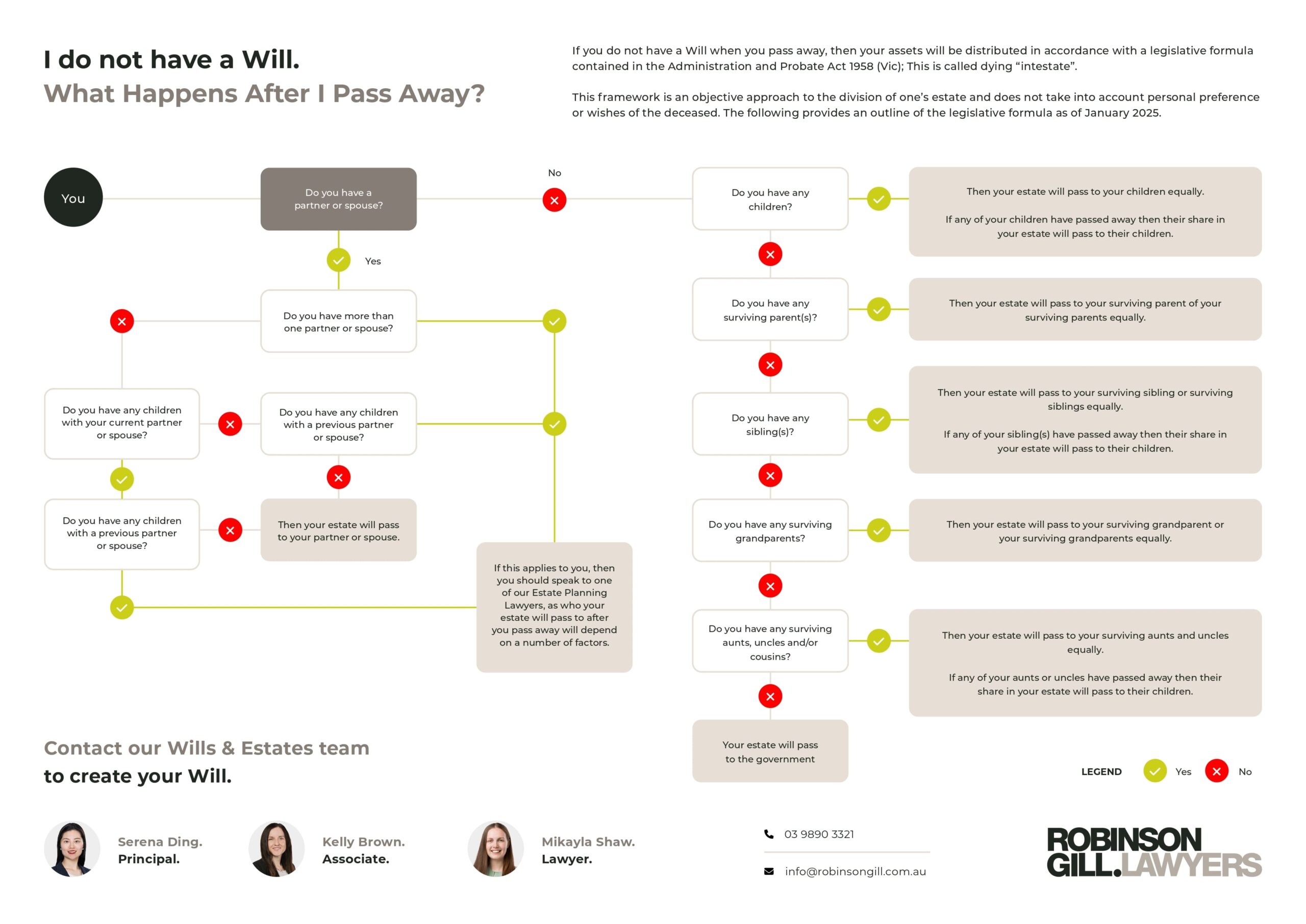
Further, this framework does not provide for friends or your pets. Therefore, if you wish to provide for your friends or pets after you pass it is important to have a Will in place.
For a more in-depth explanation of what happens to your estate if you pass away without a Will, click here.
I am still married but we have not legally separated. What happens with my assets when I pass?
Under the Administration and Probate Act 1958 (Vic) a partner is defined as a ‘person’s spouse or domestic partner’. A spouse is defined under the Act as ‘a person who was married to the person at the time of the person’s death’ - the fact that you are separated does not mean that you are legally separated.
If you do not have a Will then your spouse is considered your partner, and your estate will be divided in accordance with the framework mentioned previously.
If this is not what you want then it is important to prepare your Will and arrange for a legal separation - Robinson Gill lawyers can help you with this.
The importance of preparing a Will ASAP
A Will is an important document that deals with one’s assets after they pass away. It is important that your Will is drafted in a way that properly reflects your wishes and this often means consulting with a solicitor who can assist you with ensuring that your Will is legally binding, protects your assets and provides for a distribution to your loved ones in accordance with your wishes. Making a Will sooner rather than later is therefore advisable, as delaying the creation of your Will may cause unnecessary stress and expense for you and your loved ones if an unexpected event occurs, such as loss of capacity through accident or illness (at which time you will not be able to make a Will) or your death.
What are Powers of Attorney?
In Victoria, there are two types of Power of Attorney, an Enduring Power of Attorney and an Appointment of Medical Treatment Decision Maker document.
An Enduring power of Attorney allows you to appoint an attorney to make legal, financial and lifestyle decisions on your behalf if you lose capacity through accident or illness. For example, an attorney is able to buy and sell property, operate bank accounts, and make decisions about what type of nursing care you are able to receive.
An Appointment of Medical Treatment Decision Maker document allows you to appoint a medical treatment decision maker to make medical decisions on your behalf including consenting or refusing to consent to procedures, consenting or refusing to consent to the use of pharmaceutical products and deciding what kind of palliative care you will receive if you are not able to make these decisions for yourself.
What happens if you do not have Powers of Attorney?
If you do not have an Enduring power of Attorney and Appointment of Medical Treatment Decision Maker document and you require one for any reason, but you do not have the capacity to prepare these documents (i.e. you are in an accident that leads you to being in a coma) then someone will have to apply to the Victorian Civil and Administrative Tribunal (VCAT) on your behalf.
VCAT can then appoint a Guardian or Administrator to make decisions on your behalf. An application to VCAT can be a stressful and time-consuming process. Further, an appointment of a Guardian or Administrator may only be temporary, meaning that your family member or friend may have to return to VCAT to maintain the appointment.
If you are in this situation and require assistance with a VCAT application, please contact us.
Want to Start the Process or Talk to Someone?


How can I learn more?

Kelly Brown.
Senior Associate.
- Property and Wills & Estates
- 03 9890 3321
- Email Address: k.brown@robinsongill.com.au

Mikayla Shaw.
Lawyer.
- Wills & Estate Planning
- 03 9890 3321
- Email Address: m.shaw@robinsongill.com.au
Some other resources you
might find helpful

Pervanic v Merri-Bek City Council (Costs Ruling) [2025] VCC 1731
In the recent public liability case Pervanic v Merri-Bek City Council [2025] VCC 1731, the plaintiff was awarded a total of $85,000 by a jury on 17 November 2025, comprising $80,000 for pain and suffering, $2,000 for past medical and like expenses, and $3,000 for past gratuitous care.

Australian Credit License: What is it and do I need one?
An Australian credit licence (ACL) is a licence issued by the Australian Securities and Investments Commission (ASIC) that permits individuals or companies to engage in credit activities in Australia.

Major Family Law Property Reforms Take Effect from 10 June 2025
The Family Law Amendment Act 2024 introduces wide-reaching changes to the way property settlements are determined following separation. These amendments, which took effect on 10 June 2025, aim to improve clarity, consistency and fairness—particularly for parties affected by family violence.